
BLOG
Low Noise Scroll Air Compressor: How It Improves Workplace Comfort?

News

Contact us
Low Noise Scroll Air Compressor: How It Improves Workplace Comfort?
In modern industrial environments, workplace comfort is no longer a secondary consideration—it has become a key factor in productivity, employee health, and operational efficiency. Among the many technologies contributing to a better working environment, the low-noise scroll air compressor stands out as one of the most impactful innovations.
Compressed air systems are essential in manufacturing, medical, laboratory, and automation industries. However, traditional compressors often generate significant noise pollution, which can negatively affect workers and overall workplace conditions. The introduction of scroll technology has changed this situation dramatically.
This article explores what a low noise scroll air compressor is, how it works, and most importantly, how it improves workplace comfort across different industries.
1. Understanding the Low-Noise Scroll Air Compressor
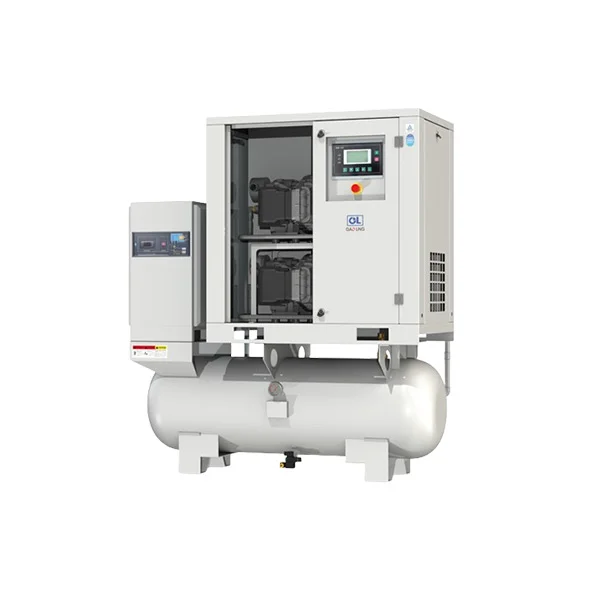
A scroll air compressor is a type of positive displacement compressor that uses two spiral-shaped scroll elements to compress air. One scroll remains fixed, while the other moves in a controlled orbital motion.
A low noise scroll air compressor refers specifically to this technology optimized for minimal sound output, often achieved through:
-
Smooth orbital compression instead of reciprocating motion
-
Reduced mechanical friction
-
Fewer moving parts
-
Advanced vibration control design
Unlike piston compressors that create loud, repetitive mechanical noise, scroll compressors operate in a continuous and smooth cycle, making them significantly quieter.
2. Why Noise Reduction Matters in Industrial Workplaces
Before understanding the technical benefits, it is important to recognize why noise reduction is critical in industrial environments.
2.1 Impact on Employee Health
Long-term exposure to high noise levels can lead to:
-
Hearing damage
-
Increased stress levels
-
Fatigue and reduced concentration
-
Sleep disturbances (for shift workers)
Workplace comfort directly affects employee well-being, which in turn influences productivity and retention rates.
2.2 Productivity and Focus
Studies in industrial psychology show that excessive noise:
-
Reduces cognitive performance
-
Increases error rates
-
Lowers attention span
A quieter environment leads to better focus and higher-quality output.
2.3 Compliance with Safety Regulations
Many countries enforce occupational noise limits. Companies must ensure that equipment such as compressors does not exceed safe decibel levels.
3. How a Low-Noise Scroll Air Compressor Works
To understand why scroll compressors are quieter, we must look at their working principle.
3.1 Dual-Scroll Mechanism
The compressor consists of:
-
A fixed scroll
-
An orbiting scroll
The orbiting scroll moves in a circular path, trapping air between the scrolls.
3.2 Smooth Compression Cycle
The process includes:
-
Air intake at the outer edges
-
Air trapping in sealed pockets
-
Gradual movement toward the center
-
Progressive compression
-
Continuous discharge of compressed air
Unlike piston systems, there is no sudden impact or reciprocating motion.
4. Why Scroll Technology Is Naturally Quiet
The low noise performance of scroll air compressors is not just a design feature—it is a structural advantage.
4.1 No Reciprocating Motion
Piston compressors rely on back-and-forth motion, which creates vibration and mechanical noise. Scroll compressors eliminate this entirely.
4.2 Continuous Airflow
Instead of pulsating bursts of air, scroll compressors provide smooth and constant airflow, reducing pressure fluctuations and sound spikes.
4.3 Reduced Mechanical Contact
With fewer moving parts and less friction, mechanical noise is significantly reduced.
4.4 Balanced Operation
The orbital motion is naturally balanced, which reduces vibration transferred to the machine frame and surrounding environment.
5. Measured Noise Levels Compared to Traditional Compressors
In general industrial settings:
-
Piston compressors: 70–90 dB
-
Screw compressors: 65–80 dB
-
Low noise scroll air compressors: 45–65 dB
This difference is significant. A reduction of even 10 dB is perceived by humans as approximately half the noise intensity.
This means scroll compressors can dramatically improve perceived workplace comfort.
6. How Low-Noise Scroll Air Compressors Improve Workplace Comfort
Now let’s focus on the core topic: how exactly does this technology improve working conditions?
6.1 Creating a Quieter Work Environment
The most obvious benefit is noise reduction. A quieter environment leads to:
-
Less stress for employees
-
Improved communication between workers
-
Better concentration in production areas
In environments such as laboratories or medical facilities, silence is often essential for precision work.
6.2 Enabling Equipment Placement Near Workstations
Traditional compressors often need to be installed in separate rooms due to noise. With a low noise scroll air compressor, installation can be closer to the point of use.
This provides:
-
Reduced air transmission loss
-
Lower piping complexity
-
More flexible factory layout
6.3 Improving Employee Health and Safety
Reducing noise exposure contributes to:
-
Lower risk of hearing loss
-
Reduced workplace stress
-
Improved mental well-being
Over time, this leads to fewer sick days and higher employee satisfaction.
6.4 Supporting 24/7 Production Environments
In industries that require continuous operation, noise becomes a long-term burden. Scroll compressors provide stable, quiet operation suitable for:
-
Shift work environments
-
Continuous production lines
-
Cleanroom operations
6.5 Enhancing Communication Efficiency
In noisy factories, workers often need to shout or repeat instructions. This can lead to:
-
Miscommunication
-
Production errors
-
Slower workflow
A quieter environment improves communication clarity and operational efficiency.
7. Key Industries That Benefit Most
The advantages of low noise scroll air compressors are especially valuable in certain sectors.
7.1 Medical and Dental Industry
Hospitals and clinics require:
-
Quiet patient environments
-
Clean, oil-free air
-
Reliable continuous operation
Scroll compressors are widely used in dental chairs and hospital air systems.
7.2 Laboratory and Research Facilities
Research environments demand:
-
Precision
-
Stability
-
Silence
Noise interference can affect experiments and measurements.
7.3 Electronics Manufacturing
Cleanrooms require both:
-
Low vibration
-
Low noise
-
Oil-free air
Scroll compressors meet all three requirements.
7.4 Food and Beverage Industry
Noise reduction improves:
-
Worker comfort
-
Hygiene-sensitive production environments
-
Packaging line efficiency
7.5 Office-Based Industrial Settings
Some modern manufacturing setups combine office and production spaces. Scroll compressors help maintain a comfortable hybrid environment.
8. Energy Efficiency and Comfort Connection
Noise reduction is not the only benefit. Many energy-efficient scroll air compressor systems also contribute to workplace comfort indirectly.
Lower energy consumption leads to:
-
Reduced heat generation
-
More stable operating conditions
-
Less cooling requirement in the workspace
This improves overall environmental comfort.
9. Maintenance Benefits That Improve Workplace Experience
Another important factor is maintenance.
9.1 Less Downtime Noise Disruption
Traditional compressors often require frequent maintenance, which involves:
-
Loud servicing procedures
-
System shutdowns
-
Operational interruptions
Scroll compressors reduce these disruptions.
9.2 Cleaner Operation Environment
Because many systems are oil-free scroll air compressors, there is:
-
No oil leakage
-
No oil odor
-
Cleaner air environment
10. Scroll Air Compressor vs Traditional Compressor Noise Experience
Piston Compressor Experience:
-
Loud mechanical impact
-
Strong vibration
-
Requires soundproof room
Screw Compressor Experience:
-
Moderate continuous noise
-
Requires partial isolation
Scroll Air Compressor Experience:
-
Smooth, low-level hum
-
Can operate near work areas
-
Minimal vibration impact
11. Future Trends in Low-Noise Compressor Technology
The demand for quieter industrial equipment is expected to grow further.
11.1 Smart Noise Control Systems
Future compressors will integrate:
-
Adaptive speed control
-
Load-based noise reduction
-
Intelligent vibration damping
11.2 More Compact Silent Systems
Manufacturers are designing:
-
Smaller footprint systems
-
Fully enclosed silent units
-
Integrated all-in-one solutions
11.3 Expansion in Urban Manufacturing
As factories move closer to cities, noise control becomes even more critical.
Conclusion
The low noise scroll air compressor is more than just a piece of industrial equipment—it is a key contributor to modern workplace comfort.
By combining:
-
Quiet operation
-
Oil-free air output
-
Energy efficiency
-
Low vibration design
-
Compact structure
it significantly improves working conditions across industries.
From medical facilities and laboratories to electronics manufacturing and food production, scroll compressors are helping create safer, quieter, and more productive environments.
As industries continue to evolve, workplace comfort will remain a priority, and low noise scroll air compressors will play an increasingly important role in shaping the future of industrial air systems.


