
BLOG
How to Choose the Right Scroll Air Compressor for Your Factory?

News

Contact us
How to Choose the Right Scroll Air Compressor for Your Factory?
Compressed air plays a critical role in modern manufacturing. From powering pneumatic tools to supporting automated production lines, a reliable compressed air system is essential for operational efficiency. As industries continue to demand cleaner, quieter, and more energy-efficient solutions, the scroll air compressor has become increasingly popular across various industrial sectors.
However, choosing the right compressor for your factory is not always simple. Different production environments have different air requirements, operating conditions, and budget considerations. Selecting the wrong system can lead to energy waste, unstable air supply, higher maintenance costs, and reduced productivity.
This guide explains how to choose the right scroll air compressor for your factory, including key factors, technical considerations, application requirements, and long-term operational strategies.
1. Understand What a Scroll Air Compressor Is
Before selecting a system, it is important to understand the basic concept of a scroll air compressor.
A scroll compressor uses two spiral-shaped scroll elements to compress air:
-
One fixed scroll
-
One orbiting scroll
As the orbiting scroll moves, air is trapped and compressed toward the center. This design creates:
-
Smooth airflow
-
Low vibration
-
Quiet operation
-
High energy efficiency
Many modern systems are also designed as oil-free scroll air compressors, making them suitable for industries requiring clean compressed air.
2. Evaluate Your Factory’s Air Demand
The first and most important step is determining how much compressed air your factory actually needs.
2.1 Calculate Air Consumption
You should evaluate:
-
Number of pneumatic tools
-
Production equipment requirements
-
Simultaneous air usage
-
Peak demand periods
Air demand is usually measured in:
-
CFM (Cubic Feet per Minute)
-
m³/min (cubic meters per minute)
Choosing a compressor with insufficient capacity can result in:
-
Pressure drops
-
Production interruptions
-
Equipment inefficiency
Oversized systems, on the other hand, waste energy and increase operational costs.
2.2 Consider Future Expansion
Many factories expand production capacity over time. When selecting an industrial scroll air compressor system, consider:
-
Future equipment additions
-
Increased production shifts
-
New automated lines
Choosing a modular or scalable system can reduce future upgrade costs.
3. Determine Required Air Quality
Air quality requirements vary greatly between industries.
3.1 When Oil-Free Air Is Necessary
An oil free scroll air compressor is essential for industries such as:
-
Medical and dental applications
-
Pharmaceuticals
-
Food and beverage processing
-
Electronics manufacturing
-
Laboratories
Oil contamination in these industries can damage products, equipment, or production quality.
3.2 Air Purity Standards
Factories should consider compliance with standards such as:
-
ISO 8573-1 air quality classifications
High-purity applications may also require:
-
Air dryers
-
Precision filters
-
Moisture separators
Many modern scroll compressor systems integrate these components into one compact solution.
4. Consider Noise Levels in the Workplace
Noise is often overlooked during compressor selection, but it significantly affects workplace comfort.
4.1 Benefits of a Low Noise Scroll Air Compressor
A low noise scroll air compressor offers:
-
Reduced workplace stress
-
Better communication between workers
-
Improved employee comfort
-
Easier indoor installation
This is especially important in:
-
Laboratories
-
Hospitals
-
Electronics production facilities
-
Office-connected workshops
4.2 Compare Noise Ratings
Noise levels are measured in decibels (dB). Lower values indicate quieter operation.
Typical comparison:
-
Piston compressor: 75–90 dB
-
Screw compressor: 65–80 dB
-
Scroll compressor: 45–65 dB
A quieter environment can improve productivity and reduce long-term occupational health risks.
5. Focus on Energy Efficiency
Energy consumption is one of the largest long-term operating costs in compressed air systems.
5.1 Why Energy Efficiency Matters
An energy efficient scroll air compressor can:
-
Reduce electricity costs
-
Lower carbon emissions
-
Improve operational sustainability
Because compressors often run continuously, even small efficiency improvements can generate significant savings.
5.2 Permanent Magnet (PM) Motor Technology
Many advanced scroll compressors use PM motors, which provide:
-
Higher efficiency
-
Stable operation under varying loads
-
Reduced heat generation
Factories seeking long-term ROI should prioritize energy-efficient motor technology.
6. Evaluate Compressor Pressure Requirements
Different industrial applications require different pressure ranges.
6.1 Typical Pressure Levels
Common industrial pressure ranges include:
-
7 bar
-
8 bar
-
10 bar
Choosing incorrect pressure can result in:
-
Reduced tool performance
-
Increased energy waste
-
Unstable production processes
6.2 Avoid Excessive Pressure
Higher pressure does not always mean better performance. Running a system above necessary pressure levels increases:
-
Energy consumption
-
Component wear
-
Maintenance frequency
Choose a compressor that matches your actual operational needs.
7. Check Installation Space and Layout
Factory space is valuable, especially in modern production facilities.
7.1 Advantages of Compact Scroll Compressor Systems
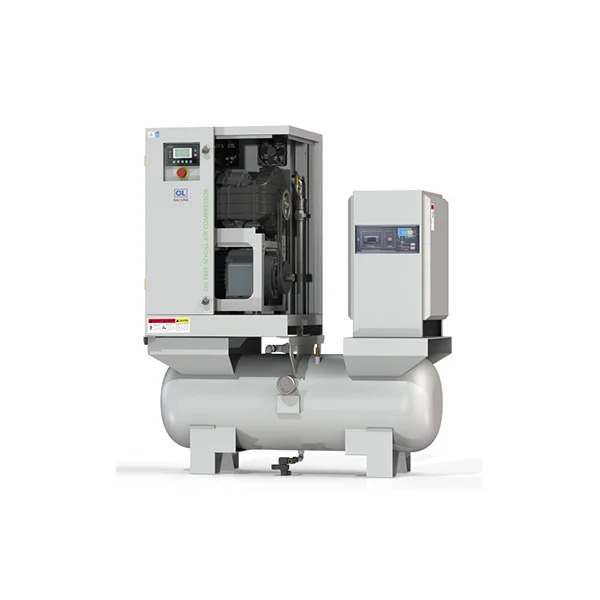
Many all-in-one scroll air compressor systems integrate:
-
Compressor unit
-
Air receiver tank
-
Dryer
-
Filtration system
This compact design:
-
Saves floor space
-
Simplifies installation
-
Reduces piping complexity
7.2 Ventilation Requirements
Even compact systems require proper airflow and cooling space. Ensure:
-
Adequate ventilation
-
Easy maintenance access
-
Stable installation surface
8. Analyze Maintenance Requirements
Maintenance directly affects downtime and operating costs.
8.1 Why Scroll Compressors Require Less Maintenance
Compared with piston compressors, scroll air compressors have:
-
Fewer moving parts
-
No oil lubrication system (in oil-free models)
-
Lower vibration levels
This results in:
-
Reduced wear
-
Lower servicing frequency
-
Longer operating life
8.2 Maintenance Accessibility
When selecting a compressor, check:
-
Ease of filter replacement
-
Accessibility of internal components
-
Availability of spare parts
Factories should prioritize systems with strong after-sales support.
9. Choose the Right Cooling System
Compression generates heat, and cooling performance affects reliability.
9.1 Air-Cooled vs Water-Cooled Systems
Air-Cooled Scroll Compressors
-
Easier installation
-
Lower maintenance
-
Suitable for most factories
Water-Cooled Systems
-
Better for high-temperature environments
-
More stable cooling performance
-
Higher installation complexity
Choose according to factory conditions and operating environment.
10. Consider Smart Control Features
Modern compressors are increasingly integrated with intelligent technologies.
10.1 Smart Monitoring Systems
Advanced systems may include:
-
Real-time pressure monitoring
-
Temperature control
-
Automatic fault alarms
-
Remote monitoring capability
These features improve operational management and reduce unexpected downtime.
10.2 IoT and Predictive Maintenance
Some industrial scroll air compressor systems support:
-
IoT connectivity
-
Energy consumption analysis
-
Predictive maintenance scheduling
This helps factories optimize production efficiency.
11. Compare Scroll Compressors with Other Types
11.1 Scroll Air Compressor vs Piston Compressor
Scroll Compressor Advantages
-
Lower noise
-
Cleaner air
-
Higher efficiency
-
Less maintenance
Piston Compressor Advantages
-
Lower initial cost
-
Suitable for small intermittent usage
11.2 Scroll Air Compressor vs Screw Compressor
Scroll Compressor
-
Best for clean air applications
-
Compact and quiet
-
Ideal for small to medium air demand
Screw Compressor
-
Better for large-scale continuous production
-
Higher airflow capacity
Factories should select based on operational scale and air quality requirements.
12. Evaluate Total Cost of Ownership
Many buyers focus only on purchase price, but the real cost includes:
-
Energy consumption
-
Maintenance
-
Downtime risk
-
Replacement parts
-
Equipment lifespan
A high-quality energy efficient scroll air compressor may cost more initially but save significantly over its operating life.
13. Work with a Reliable Manufacturer or Supplier
Choosing the right supplier is just as important as choosing the right compressor.
A reliable manufacturer should provide:
-
Technical consultation
-
Customized solutions
-
Spare parts support
-
Warranty service
-
Fast after-sales response
Factories should evaluate supplier experience and industry reputation before purchasing.
Conclusion
Choosing the right scroll air compressor for your factory requires careful evaluation of air demand, pressure requirements, air quality standards, energy efficiency, noise levels, maintenance needs, and future expansion plans.
A properly selected system can:
-
Improve production efficiency
-
Reduce operational costs
-
Enhance workplace comfort
-
Deliver stable, clean compressed air for years
Whether you need a low noise scroll air compressor, an oil free scroll air compressor, or a fully integrated industrial scroll air compressor system, understanding your factory’s actual requirements is the key to making the right investment decision.
As industries continue moving toward cleaner and more energy-efficient manufacturing, scroll air compressor technology will remain one of the most reliable and future-ready compressed air solutions available today.


